
The Evolution of Inkjet Printing: From Graphical Printing to High-Viscosity Industrial Deposition
How four waves of innovation are bringing inkjet to industrial manufacturing.
March 31, 2026
Ben Hartkopp
Our NovoJet® printhead didn’t start with a blueprint; it started with a question. How could we get our hands on a deposition method that would be fast and resilient enough for the low cost resins and conductive inks that we had available for printing our own circuit boards. We took a first-principles approach and combined it with a high rate of design iteration and testing, deconstructing the problem to its bare fundamentals and through that lens, it became clear: Inkjet had massive potential beyond the accepted norms and was the only viable technology for the challenges we wanted to solve.
But identifying the medium was only the beginning. To build a truly disruptive technology, we had to understand every brick of the foundation already laid. I spent many months in the trenches, looking through thousands of patents and technical documents, from the household giants to the lost innovations that never made it to market.
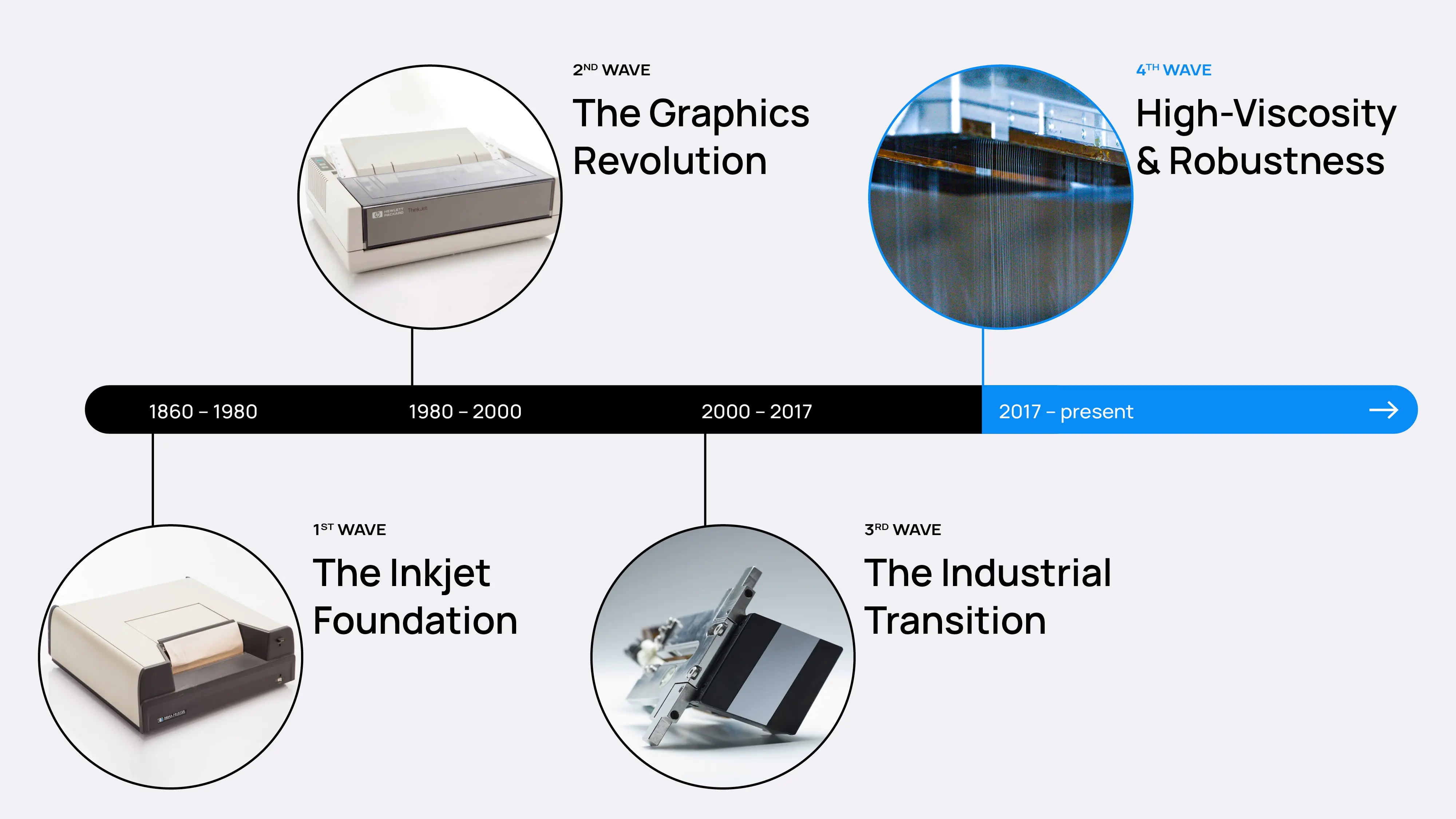
Through this research, I’ve observed that inkjet developments have seemingly emerged in distinct clusters. Much like the sets of waves in an ocean, the industry seems to move in cycles of innovation.
For decades, we’ve watched three distinct waves wash over the market. Each one pushed the limits of what was possible, but they were largely obsessed with a single metric: resolution.
As time moves on, it is becoming clear that resolution alone is no longer the only benchmark for the future of inkjet. We are now entering a Fourth Wave where the industry’s demands have shifted from mere aesthetics to robustness, flexibility, and functionality. This era is about moving inkjet technology out of the office and onto the factory floor, adapting it to survive the rigors of industrial implementation across complex surfaces and new materials. In the following sections, I will explore each of these waves, examining the noteworthy events and innovations that defined them before taking a deep dive into the Fourth Wave we are currently preparing for, and the advancements that have already begun to take shape.
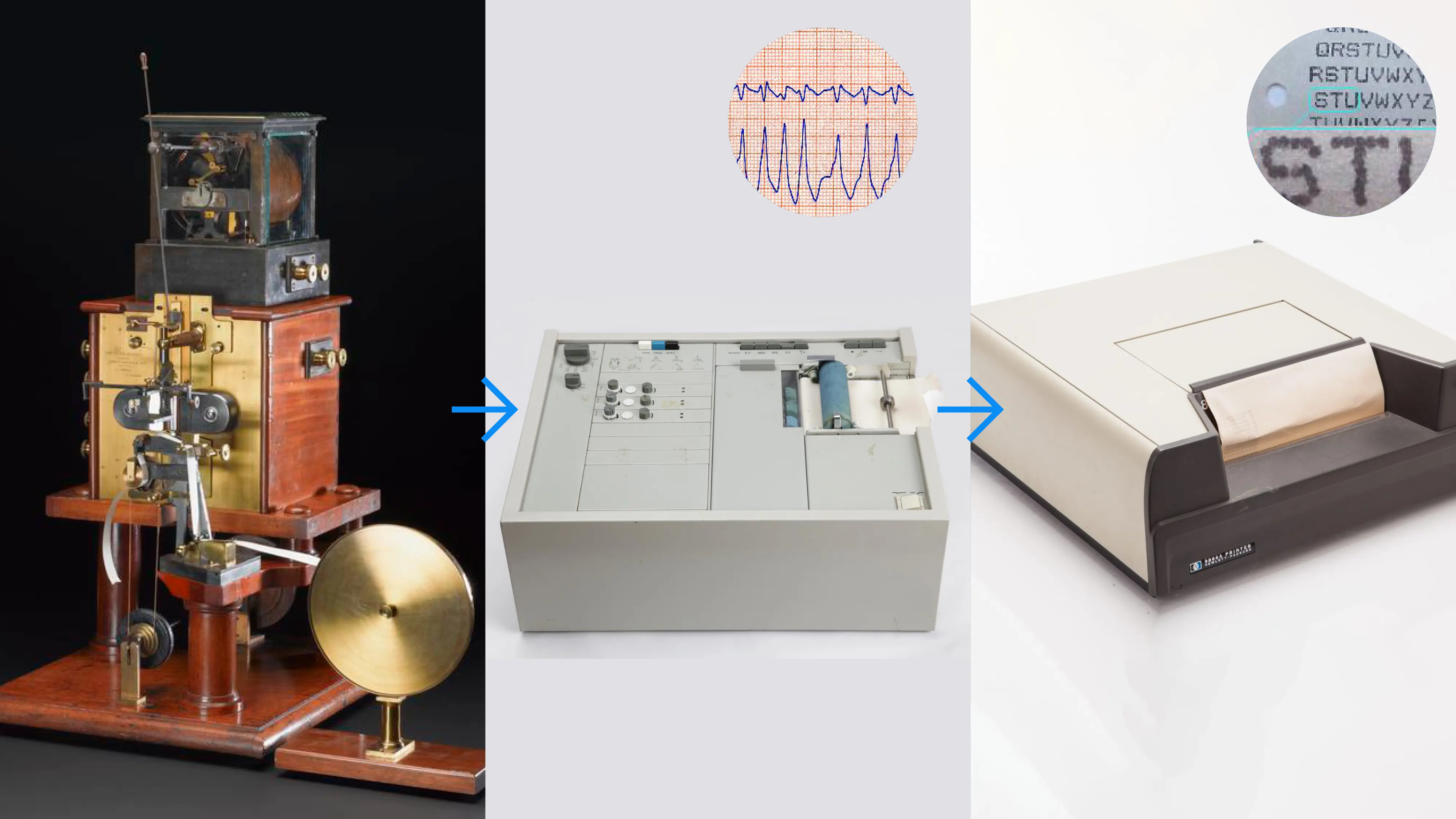
Surprisingly, inkjet was not found for printing, but in the need to record high-speed data. In 1867, Lord Kelvin patented the Siphon Recorder, a capillary-fed device designed to record telegraph signals transmitted through undersea cables. By using electrostatic forces to deflect a continuous stream of ink, Kelvin bypassed the friction and inertia of mechanical pens, allowing for the capture of weak, rapid electrical pulses. This established the fundamental "Continuous Inkjet" (CIJ) principle that would eventually define the industry's first century. Even today, inkjet heads are referred to as recording devices in some patent applications.
By the 1950s, Siemens took these principles and industrialized them for the medical field, specifically for devices like the Mingograf ECG. This period marked the critical shift from experimental recording to functional jetting instrumentation, proving that fluids could be controlled with enough precision to represent complex data. As the 1960s arrived, the emergence of dot-matrix "needle” printers introduced the X-Y coordinate logic that would underpin all future digital deposition, providing the spatial framework needed to move from simple lines to structured patterns.
The second wave was an era of explosive commercialization and intense intellectual property battles, famously known as the IP wars. In 1984, HP and Canon independently launched Thermal Inkjet (TIJ) technology, which revolutionized the market by using heat to create microscopic bubbles that ejected ink. Parallel to this, the MEMS (Micro-Electro-Mechanical Systems) revolution allowed engineers to etch thousands of microscopic nozzles onto silicon chips, enabling the mass production of low-cost, disposable printheads that brought high-quality color to the desktop.
However, this era of commoditization also birthed a resolution bias that would stall industrial progress for decades. Manufacturers became obsessed with dots per inch (DPI) and photo-realistic speed, optimizing their systems for very low viscosity fluids that were easy to jet but physically fragile. While these heads were perfect for low viscosity inks, they were fundamentally unsuited for the harsh environments and challenging fluids required for real-world production and industrial manufacturing.

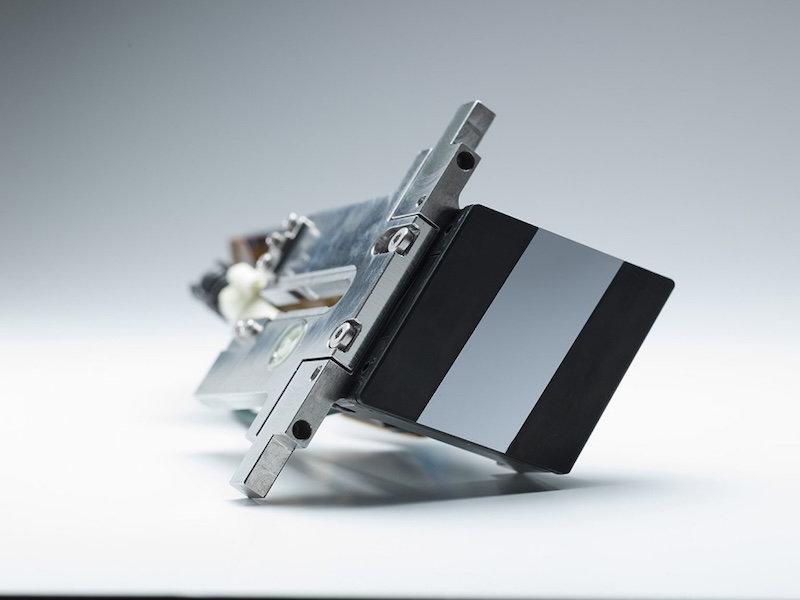
As the consumer market matured, inkjet began its first serious attempt to replace traditional analog methods in specialized industrial sectors like ceramics and labeling. This third wave saw the introduction of internal recirculation technologies from companies like Xaar and Fujifilm Dimatix. By creating a constant flow of ink behind the nozzle, these systems could finally handle pigments that would otherwise settle and clog the printhead, allowing inkjet to move onto ceramic tiles, wide-format graphics and high-speed bottle labeling.
Despite these advances, the industry hit what we call a rheology wall. These systems were essentially graphics-based architectures adapted for industrial use, rather than being built for industry from the ground up. They remained highly sensitive to temperature fluctuations and slight variations in material batches. While they increased viscosity margins slightly, they lacked the inherent robustness needed to handle the truly difficult fluids that dominate modern manufacturing.
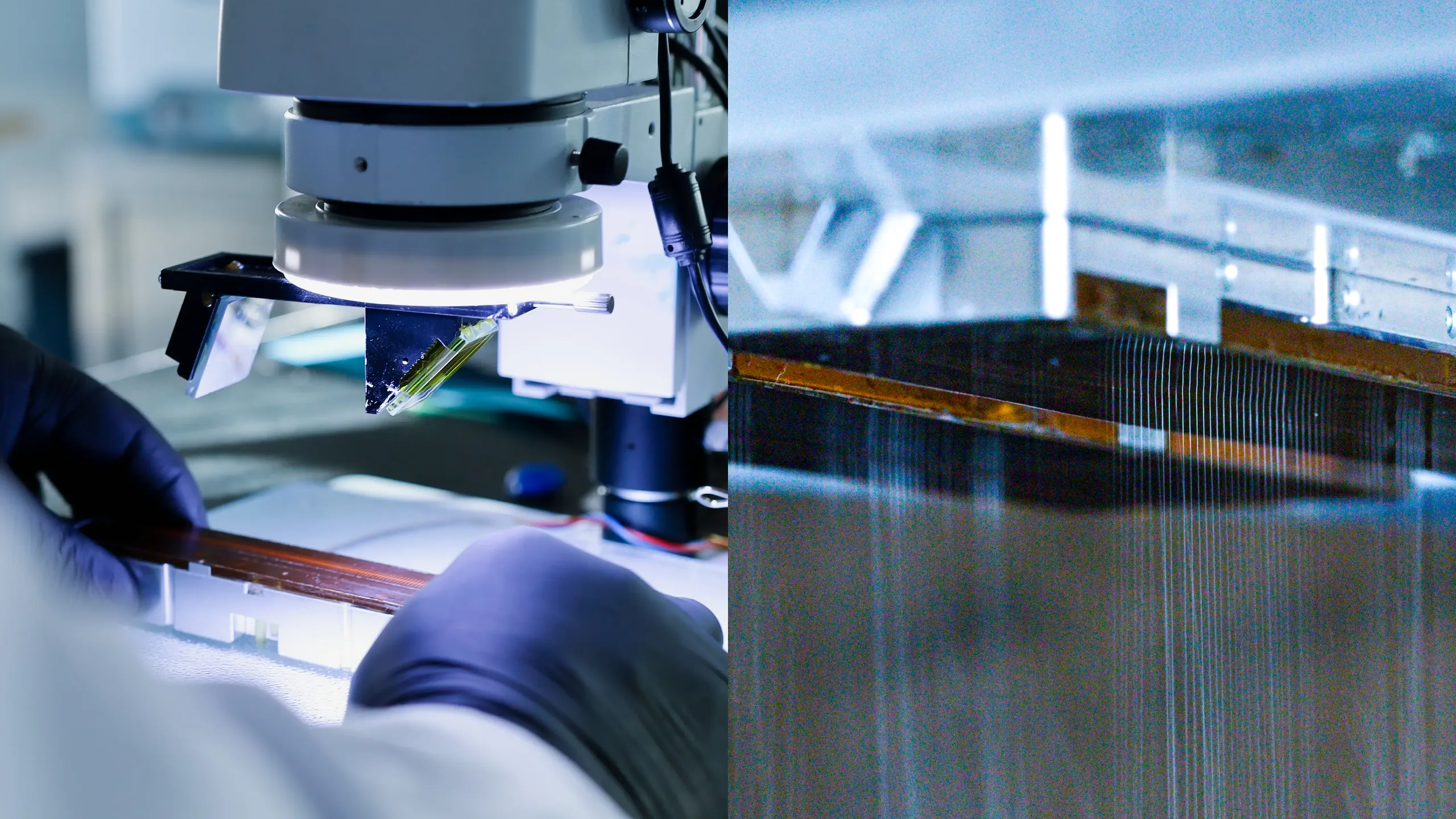
The current frontier of technology development has a new focus: high viscosity jetting for the digitization of industrial manufacturing. This era demands a departure from traditional heads that rely on multi-pulse acoustic actuation at the Helmholtz resonance. While resonance can coax slightly thicker fluids through a nozzle, it requires incredibly complex waveforms that break down the moment a material’s rheology changes. In a factory environment, where temperature and material batch consistency inherently vary, especially for polymeric fluids, this reliance on resonance becomes a point of failure and requires time intensive waveform adjustments or make materials plainly unjettable.
Quantica’s approach focuses on the "Robustness Advantage" of single-pulse volumetric displacement. By using a direct mechanical action rather than harmonic resonance, our technology offers the headroom necessary for real-life integration. We are jetting select materials at >250 mPa·s at the point of ejection, allowing us to process almost newtonian fluids that exceed 15,000 mPa·s at room temperature and highly thixotropic materials at potentially even higher viscosities. This shift moves inkjet away from "printing an image" and toward "depositing a material," positioning digital technology to finally displace analog screen printing, dispensing and spray coating in high-stakes fields like electronics, medtech and automotive manufacturing.
Moving into this fourth wave is not a "plug and play" endeavor. Because the environments are significantly more complex and the materials are so much more varied, successful implementation requires:
The journey from Lord Kelvin’s siphon to high viscosity jetting is a testament to iterative innovation. At Quantica, we believe the future of digital manufacturing belongs to systems that prioritize robustness over sheer pixel count. Only then can we move from printing an image to digitizing the factory.

From application development in e-motors and fuel cells to international conferences and events in H1, the Quantica team is preparing for an exciting second half of the year.
.png)
.webp)
Quantica introduces a new method for industrial adhesive application in E-Stack bonding and sealing.

CEO Stefan Holländer shares his view on Quantica's strategic focus and future.